Honest accounting for the one input we can’t reissue: a physical currency for ecological cost that can’t be printed, offset, or discounted — so the market conserves on its own.
J.W. SHER
Environmental or resource economist? Free Market Ecology for Skeptical Environmental Economists — a direct comparison with the policy toolkit you already know.
Featured: Free Market Ecology: First Principles — the complete system built from the ground up, error by error.
The Last Whale — Julian Simon was right about markets and scarcity; why the robot era is exactly when that stops being true.
The Number Nobody Chooses — what the end of wage labor does to who the economy keeps on its books.
Three Ancestors — the intellectual lineage behind Free Market Ecology: Henry George, the Austrians, and ecological economics.
The Last Barrels — how Free Market Ecology handles peak oil.
The Mansion Paradox — how Free Market Ecology solves the density problem without banning sprawl.
The Abdication — the whole framework as a story: how the owner of an island grew richer by giving it up.
What Free Market Ecology Is
Free Market Ecology extends the market’s price mechanism to the one domain capitalism leaves outside it: the environment. Capitalism processes information about labor and capital better than any planner can, and it processes almost nothing about ecological cost, because ecological cost carries no price. Free Market Ecology gives it one.
In our current system, the private market creates capital and allocates labor with extraordinary efficiency using price signals. Environmental protection, however, is left to government central planners who must manage ecological outcomes without real-time market information, much as communist states managed capital creation without price signals. Free Market Ecology moves environmental protection into the market, making it the work of entrepreneurs and competition rather than bureaucratic administration. As I argue in Extending Capitalism’s Logic, it puts the environment inside the price system instead of leaving it to planners standing outside the market.
What Breaks When Labor Costs Nothing
Capitalism’s engine is the markup of labor. An entrepreneur pays a worker $10 per hour and sells the output for $20. The difference is profit. This single mechanism built the modern world. Every investment, every innovation, every competitive advantage ultimately comes down to getting more output per unit of labor cost.
As AI and robotics drive labor’s share of production toward zero, that markup loses its footing. The closer labor cost gets to nothing, the less the profit motive that directed centuries of innovation has to work with. As I show in The Economic Math Behind Free Market Ecology, the markup that powered three centuries of investment thins toward nothing as wage costs vanish, and competition bids away what is left. The engine that ran capitalism runs out of fuel.
Labor cost is also the brake. Every resource a process consumes has to be worth the human labor of extracting and handling it, and for as long as there have been workers that has held resource use roughly in check. Automation lifts the brake. A resource constraint that took human economies centuries to reach, an automated economy can reach in years, with no worker ever stopping to ask whether the next ton of ore is worth the trouble of digging.
What remains when labor is worthless? Raw resources. The physical limits of the Earth. The government must step in to regulate every use of resources, and that regulatory apparatus will have to grow until it touches nearly all economic activity. Capitalism will have reproduced central planning through the back door, as the environmental protection bureaucracy becomes the planning committee deciding who may use which resources and how much.
The Resource Markup: A Successor Engine
Free Market Ecology replaces the labor markup with a successor: the markup of resources.
The resources and externalities whose physical scarcity genuinely binds are tracked through Resource Usage Rights (RURs), capped units that travel with materials through the entire supply chain. The set of tracked dimensions is deliberately bounded — a few dozen globally standardized units at most, with everything outside the set handled in ordinary money, as today. A producer who uses resources more efficiently than competitors can mark up the RURs in their products and keep the difference as profit. This is structurally identical to how capitalism marks up labor, but it operates across dozens of resource dimensions simultaneously.
Consider a rare earth processor who develops clean technology that eliminates the acid lakes created by conventional processing. As described in The Rare Earth Tailing Pond Dilemma, the clean processor borrows almost no acid-land-damage RURs (because the actual damage is near zero), but sells the product at a markup that reflects the damage consumers would otherwise accept from dirty competitors. The entire spread between near-zero actual damage and the market price of damage becomes profit, paid in freed-up pieces of the Earth’s carrying capacity.
The resource markup is zero-sum with respect to the Earth. The clean rare earth processor’s profit does not create new ecological budget. It redistributes consumption rights from dirty competitors to the clean innovator. The total cap remains fixed. What changes is who gets to use the budget and how efficiently they use it. The markup is the market’s reward for moving consumption from wasteful hands to efficient ones, not a license to consume more.
This is not one markup engine like capitalism has. It is dozens of markup engines running simultaneously, each directing entrepreneurial energy toward a specific dimension of ecological efficiency. The cumulative force of these engines would drive resource-saving innovation with the same relentless intensity that capitalism’s single labor markup drove labor-saving innovation for three centuries. A traditional economist would object that we already have tools for this: Pigouvian taxes, carbon credits, tradeable permits. But each of these tools fails in a way that resource markups do not.
Pigouvian taxes require a bureaucrat to set the “right” price for damage. But as Hayek showed, the knowledge needed to price dozens of interacting ecological costs across millions of localities is dispersed among the actors themselves. No tax authority can calculate the correct rate for nitrogen runoff in Iowa and rare earth tailings in Guangdong and freshwater depletion in the Aral basin simultaneously. They will be wrong more often than right, are routinely captured by the industries they regulate, and adjust more slowly than conditions change.
Carbon credits and tradeable permits separate the damage from the product. A factory buys a carbon offset from a tree-planting project in Brazil, and the damage vanishes from its balance sheet. But the physical damage travels with the product through every stage of the supply chain. Only a system that tracks resource costs through the entire chain, from extraction to consumption, keeps the ecological truth attached to the economic object. As I demonstrate in The Rare Earth Tailing Pond Dilemma, the moment you detach the cost from the product, you lose the markup incentive that drives clean innovation.
Tradeable permits become financial assets. They can be hoarded, speculated on, and financialized, exactly the behaviors that make holding oil in tankers a rational strategy for a trading house in the current system. The permit holder’s incentive is to restrict supply and raise the permit price, not to reduce damage.
Most critically, all of these tools operate on one dimension at a time. A carbon tax addresses carbon. A water rights market addresses water. A fishing quota addresses fish. This is not a design limitation that cleverer policy could fix. It reflects a physical reality: fresh water is not carbon. Nitrogen runoff is not habitat loss. These are fundamentally different ecological constraints that cannot be collapsed into a single metric without destroying the information the system needs to function. Non-fungibility across resource dimensions is physics, not a design choice.
Free Market Ecology creates dozens of markup engines running simultaneously across the tracked resource dimensions, each one an independent profit incentive for ecological efficiency. Consumers navigate this multi-dimensional budget through a resource exchange where they can trade their personal allocations: someone who cycles to work can trade unused fuel RURs for extra water RURs to fill a swimming pool. These exchanges shift the micro-distribution of who uses what, but the Ecological Central Bank never prints carbon RURs to cover water RURs. Each macro cap remains independently binding. The exchange trades allocations, not caps. No patchwork of single-dimension taxes and permits can replicate the systemic force of entrepreneurs competing to mark up resources across every dimension at once.
RURs Are Credit, Not Permits
The most common misunderstanding of Free Market Ecology is that RURs are just tradeable permits by another name. They are not. The difference is structural, and it changes how the whole system behaves.
In cap-and-trade systems, a permit is an asset. You buy it, you own it, you can hold it forever. This invites hoarding, speculation, and the financialization of environmental markets. A trading house holding oil in tankers waiting for prices to rise is the current system working as designed.
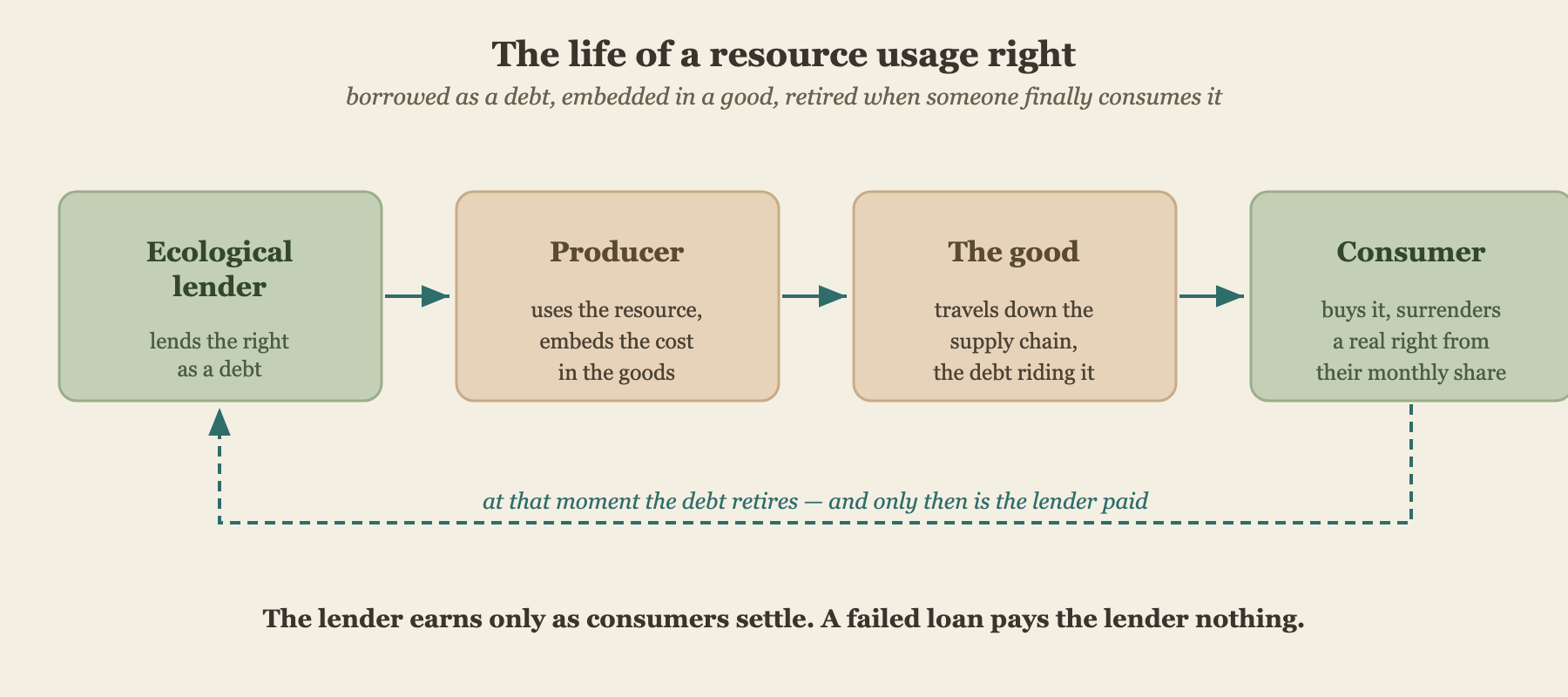
In Free Market Ecology, RURs are a form of credit. A producer borrows them from Ecological Private Finance (EPF) against posted collateral, and they sit on the producer’s ecological balance sheet as a liability. What keeps that liability moving is not a charge for holding it — there is none — but the ordinary discipline of a secured loan: the advance carries a repayment deadline, and if the producer has not settled by then, by selling the goods downstream to a buyer who finally surrenders a real right, the lender forecloses on the unsold inventory, exactly as a secured lender forecloses on collateral today. Two further forces push the same way. The lender’s own return arrives only when the goods reach final consumption, so a position that merely sits earns its lender nothing. And flow rights — a month of land, a season’s water — expire at the month’s end, so idle rights lapse rather than accrue. EPF still prices each loan by the borrower’s creditworthiness, exactly as commercial banks do, so a proven rare earth processor borrows on better terms than an untested startup, directing resources toward the producers most likely to use them efficiently. Every force points away from hoarding and toward the same behavior: use the resource in production, sell the product downstream, and clear the liability.
RURs run on two sides of a ledger, and only one side is a producer’s to hold. A producer’s RURs are borrowed credit, a debt rather than an owned, tradeable asset, and that is what makes the system structurally resistant to financialization. The asset side belongs to the public, the resource dividend every citizen holds and spends, which is what retires the producer’s debt when goods are bought. You cannot pledge a debt you owe as collateral for another loan. Attempting to do so is check kiting, not secured lending. A carbon RUR on your balance sheet is an obligation to account for carbon you extracted or received, not a valuable instrument you can leverage. This eliminates the entire class of derivative speculation that plagues cap-and-trade markets. There is no RUR-backed security, no RUR futures market divorced from physical resource flows, no warehouse play. The only way to profit from RURs is to use resources efficiently and sell products downstream at a markup.
There is a deeper reason the speculation that plagues commodity and permit markets cannot do real damage here: hoarding a right is not hoarding the resource. When a trader corners physical oil and parks it in tankers, the oil is pulled out of the ground and locked away, restricting supply and depleting the reserve at the same time. An RUR is only a capped right to extract or emit, so holding one without exercising it leaves the physical resource exactly where it was, in the ground. The worst a rights-hoarder can do is sit on paper while the Earth keeps the molecule, which means the speculative failure mode of every commodity market inverts here into conservation. The only residual concern is a holder cornering a thin local market to deny rivals access, and that is blunted by the monthly expiry of flow rights — an idle hoard lapses rather than accrues — the periodic renewal of caps, and the universal resource income every person already holds.
Where, then, does the government’s own resource budget come from — if not from a charge on credit? Not from any such charge; there is none to recycle. RURs enter circulation through two taps and two only: each citizen’s resource income, their ownership share of the capped commons, and the government’s own share of the mint, which it spends on public goods much as it spends tax revenue today. The caps bind the total either way; what the two taps decide is merely who gets to spend the fixed budget first. Nothing here is deflationary, because nothing is being drained: a good’s ecological cost rides with the good until a consumer settles it, and that settlement returns the right to the system to be minted again next period, rather than burning it away.
This credit structure creates a systematic preference for leaving resources in the ground until the supply chain is ready to consume them. Resources still in the earth cost nothing. Extract early and you carry a loan running against the lender’s repayment deadline while the stock sits in a yard that draws its own land-rights; leave it in the ground and you carry neither. The Earth itself becomes the optimal warehouse. As I describe in The Financial System of Free Market Ecology, this credit mechanism extends through the entire chain from the Ecological Central Bank through private finance to producers and consumers.
The Financial System series continues in four newer essays: The Unusual Afterlife of a Failed Loan, on what a loan becomes when it can only be repaid by the consumer who finally settles it; What Free Market Ecology Doesn’t Handle, on the line between the books and the ballot — the political questions the framework prices but never decides; The Number Nobody Chooses, on what the end of wage labor does to who the economy keeps on its books; and The Last Whale, the Austrian case — why the market’s answer to scarcity, correct for two centuries, breaks in the robot era.
The Ecological Central Bank Is Not a Central Planner
The Ecological Central Bank sets scientifically determined caps on resource extraction, the maximum sustainable use of each resource type. This is the system’s only centralized function, and it is scientific rather than economic: determining how much oil, nitrogen, freshwater, and habitat the Earth can sustain, not deciding who gets to use it. The market handles allocation within the caps.
The knowledge problem that Hayek identified in “The Use of Knowledge in Society” (1945), that no central authority can process the distributed information needed for efficient allocation, is addressed through federalism. The Ecological Central Bank is not a single global institution. It is a federation of nested jurisdictions. A local watershed authority sets nitrogen caps based on local water quality science. A national government sets mineral extraction caps based on national geology. Global coordination is needed only for genuinely planetary systems like atmospheric carbon. Each jurisdiction manages what it can observe at its own scale, and competitive pressure between jurisdictions creates feedback: if one jurisdiction sets caps poorly, the consequences are local, and others learn from the failure. The risk of corruption in government resource sustainability estimates is real, but it exists in every conceivable system that manages resources. The only alternative that eliminates it entirely is eco-primitivism, abandoning technology and returning to a pre-industrial state. But eco-primitivism is not stable: within a few thousand years, societies reindustrialize and face the same problems with even fewer resources. FME does not eliminate the corruption risk. It contains it through jurisdictional competition and bilateral enforcement.
International trade between jurisdictions is governed by bilateral penalty rates, not global price discovery. Each importing jurisdiction decides which foreign caps it trusts and imposes penalty rates on RURs from jurisdictions it considers unreliable. A jurisdiction with credible, well-enforced caps faces no penalties when its products cross borders. A jurisdiction suspected of inflating its caps or tolerating violations faces penalty rates that make its exports more expensive, punishing its economy and creating political pressure for reform. This is a multi-dimensional generalization of William Nordhaus’s Climate Club proposal: instead of a single carbon tariff, each jurisdiction evaluates the full spectrum of ecological caps in its trading partners and sets penalty rates accordingly. No global inspector is needed. Each jurisdiction protects its own ecological integrity by penalizing imports from jurisdictions that cheat.
FME handles routine ecological accounting: the daily flow of resources, the settlement of debts at consumption, the markup incentives. But criminal law remains for severe irreversible damage. Illegal dumping of toxic waste, deliberate destruction of critical ecosystems, knowing falsification of RUR records — these are not accounting errors to be corrected by interest rates. They are crimes prosecuted under environmental criminal law, with penalties including imprisonment. The RUR system makes routine compliance automatic and profitable. Criminal law handles the cases where someone bypasses the system entirely.
Why the System Enforces Itself
The most common objection to any tracking system is evasion: why wouldn’t producers simply lie? The answer is that FME’s enforcement is built into the financial structure itself, not layered on top as regulation.
Every RUR transaction is a bilateral credit relationship. When a producer borrows RURs from Ecological Private Finance and sells product downstream, both parties have a record. Default means collateral seizure — the EPF takes the producer’s posted assets. This is not a fine imposed by a regulator after years of litigation. It is automatic contractual enforcement, the same mechanism that makes mortgage payments reliable without a government inspector visiting every house.
Collusion between supply chain levels is self-defeating. If an extractor underreports resource use, the products entering the next stage of the supply chain carry anomalously low embedded RURs. Downstream competitors see these numbers and investigate, because anomalously cheap inputs from a competitor threaten their market position. The extractor who underreports also forfeits their markup on the unreported units — they extracted resources but cannot claim the RUR profit from selling them honestly. And the EPF entities that lend to producers have a direct profit motive to detect fraud, because undetected default means they lose their collateral.
Shell companies and fly-by-night operations cannot game the system because EPF requires collateral before issuing RUR credit. The collateral is physical: land, equipment, inventory with embedded RURs. Not cash, not promises, not paper assets that can be moved offshore. A shell company with no physical assets gets no RUR credit and therefore cannot extract or process resources within the system. Default means losing your business, not paying a fine that a shell company was designed to absorb.
Universal Basic Income Without the Resentment
Every UBI proposal runs into the same political wall: why should a worker subsidize someone else’s idleness? In a single-currency system, this objection is legitimate. Money from UBI gives the recipient a claim on other people’s labor.
Free Market Ecology dissolves this problem by separating resources from labor. Every person receives a flow of RURs as their ownership share of the capped commons — the atmosphere, the aquifers, the fisheries, the resources every producer must buy their way into. It is not funded by taxing anyone, because it is not a transfer at all: it is the commons paying out each owner’s share of the physical resources the economy has to use. This is not a tax on productive activity, and it is not a claim on anyone’s labor. If a product is fully automated, produced entirely by robots with no human labor, its only cost is the resources consumed. The UBI recipient can acquire it by spending their RURs. No human worked to make it. No one’s labor is being commanded.
Traditional money continues to function for human labor, creativity, and subjective value. If a product involves human effort, it has a price in money on top of its resource cost. The person living on resource UBI alone cannot hire a plumber, eat at a restaurant with a human chef, or buy handmade furniture without earning money through their own contribution. The worker’s fairness intuition is respected because nobody commands their labor without reciprocating. As I discuss in Simplified Consumption in Free Market Ecology, the complexity of managing a multi-resource budget can be handled through resource exchanges, AI assistants, and all-inclusive service providers.
AI Safety Through Budgets, Not Bureaucrats
You own a mountain. You have a robot army. You tell them: carve this mountain into a 500-foot statue of me. In the current system, the only thing that stops you is a government bureaucrat. An environmental review board. A zoning commission. When AI makes the labor free, every person with access to robots can reshape their environment at industrial scale. The number of bureaucrats needed to review all of them is impossibly large. This is central planning arrived at through ecological necessity.
In Free Market Ecology, the AI does not need permission from a bureaucrat. It needs RURs. It checks the resource budget, calculates the ecological cost across every dimension, and reports: this project costs more RURs than you have. It then proposes alternatives that fit the budget. The constraint is structural, automatic, and operates at machine speed. One AI with a budget requires zero bureaucrats. A billion AIs with budgets require zero bureaucrats.
The paperclip maximizer problem, an AI converting mountains into paperclips because its objective function has no ecological constraint, runs out of budget in FME. Every unit of production requires RURs. The AI hits its resource budget after the first few tonnes of steel and optimizes within the constraint instead of consuming without limit. The budget binds any agent operating inside the property system; an AI that ignores property law outright is a security problem for collateral seizure and criminal law, not an economics problem. For the millions of ordinary AIs acting on their owners’ behalf, this is AI safety through guardrails rather than guards, through budgets rather than alignment.
And the people who say AI will solve all environmental problems are proposing something worse than they realize. An AI managing resources without a market is just a central planner running on GPUs. It must decide who gets to live on the coast and who does not, who eats avocados and who does not, who flies and who stays home. Every allocation is a trolley problem, a political choice disguised as a technical one. Free Market Ecology keeps the market. People bid with their RUR budgets. Human creativity, taste, competition, and values determine allocation, not an algorithm’s approximation of those things. Without a market, the AI planner must either allocate randomly, which no one will accept, or adopt some group’s preferences about who deserves what, which means whoever controls the AI’s objective function controls the economy. The likely result is AI-enforced kleptocracy: whichever clique captures the planning apparatus directs resources to its allies and starves its rivals, now at machine speed and with algorithmic legitimacy. Free Market Ecology keeps the market instead.
Why Resource Seizure Stops Paying
The history of wealth has three eras, and each era determined whether war was rational.
The Spanish viewed wealth as gold to be seized. Their empire ran on treasure fleets hauling silver from Potosí and gold from the Americas. The Casa de Contratación enforced monopoly controls on all colonial trade, because wealth meant metal in the treasury and fiscal power flowed from controlling specie. Conquest was the path to riches. War was zero-sum: your gold is my gold if I take it.
The British figured out that wealth was productive capacity to be built. The factory system, canal networks, and eventually railroads created more wealth than any treasure fleet ever hauled home. Free workers with capital produced more than slaves. Conquest shifted from plunder to market access. War became less rational but still occurred over resources and trade routes.
Free Market Ecology redefines wealth a third time: wealth is the efficiency with which you transform ecological resources into human value. Under this definition, possessing resources is not wealth. Processing them efficiently is wealth. And efficiency cannot be seized. It must be developed.
If China processes rare earths more efficiently than America, the rational move is to send your ore to China and share the markup, not to fight a war over mines. Resource hoarding becomes as economically dead as the Spanish gold that caused inflation while England built factories. As I explore in Supply Chain Resource Tracking, the RUR system makes comparative advantage structural rather than advisory: resources flow to the most efficient processor not because a treaty mandates it, but because the markup makes it profitable for every actor in the chain.
It is the move the Treaty of Westphalia made with religion. Westphalia did not settle the theology. It made the theology irrelevant to whether states went to war. Free Market Ecology does that to resource disputes, by changing what wealth is so that seizing the resource no longer captures the wealth.
Consider the progression. Spain fought wars to seize gold mines and silver deposits, wars the British would never have fought because productive capacity cannot be seized from a hostile population. You can take the mine but not the Manchester textile industry. Britain, in turn, fought wars over trade routes, chokepoints, and raw material access: the Opium Wars to force open Chinese markets, wars in the Middle East to secure oil supply lines. Under Free Market Ecology, these wars become pointless. If Chinese processors mark up rare earths more efficiently, the rational move is to ship ore there and share the markup. Seizing a trade route gains nothing when the value lies in processing efficiency that cannot be captured by force. The Suez crisis becomes an anachronism, not because nations become peaceful, but because the economic logic of war evaporates when wealth is efficiency rather than possession.
Getting There From Here
Free Market Ecology does not require a revolution. It requires a series of practical improvements to systems that already exist. Individual Transferable Quotas in fisheries are functioning single-resource RUR markets. Nutrient credit trading, as described in Extending Capitalism’s Logic, is a working piece of FME operating inside the current system. Carbon cap-and-trade markets, forest certification chains of custody, and water rights markets are all fragments of the framework.
A system this comprehensive was not feasible even twenty years ago. The transaction costs of tracking every resource unit through every supply chain stage would have exceeded the value of the tracking itself. The collapse of digital transaction costs — the same force that made global e-commerce, real-time payment processing, and blockchain-based record-keeping practical — is what makes FME implementable now. The infrastructure that tracks a package from Shenzhen to your doorstep can track the RURs embedded in it.
The implementation starts with critically depleted resources where tracking infrastructure already exists: fisheries, carbon, endangered hardwoods. It extends to established environmental markets: water rights, nutrient credits. It expands as the infrastructure matures and depletion pressures make the cost of not tracking exceed the cost of tracking. Not every resource needs to be tracked. Seawater will never need an RUR. The system covers only what matters, starting with what matters most.
The path from here to a fully functioning Free Market Ecology is not a single political decision. It is the organic expansion of resource tracking, jurisdiction by jurisdiction, resource by resource, until the system is largely in place without anyone having had to approve the whole thing at once. People do not vote for “replace capitalism.” They vote for “fix the fisheries” and “make carbon credits honest” and “track rare earth supply chains.” The pattern assembles itself from the pieces.
The Depopulation Incentive — and Why Ownership Defuses It
When human labor becomes worthless, authoritarian systems face a terrible arithmetic. Every person alive consumes resources. Their economic contribution is zero. Fewer people means more resources for the remaining people. Every centrally planned economy in history has faced this arithmetic, even if they did not always state it openly. Mao’s Great Leap Forward accepted mass starvation as a cost of industrialization, implicitly valuing the surviving industrial base over the tens of millions who died. The Khmer Rouge evacuated cities and worked millions to death in pursuit of an agrarian utopia where fewer, “purer” citizens would share the land. Stalin’s deportation of entire ethnic groups to Central Asia combined political repression with a resource logic: emptied regions became available for loyal settlers and state farms. In each case, the system’s structure made fewer people a path to more resources per remaining person, even when the ideology never said so explicitly. AI and robot armies make this logic executable at total scale.
Free Market Ecology eliminates this incentive. Every person receives a resource allocation. No central authority controls aggregate allocation in a way that benefits from fewer people. Population stabilizes voluntarily as families balance the number of children against per-child resource availability, the same mechanism that reduced family sizes in every developed economy, but with resource visibility rather than just financial pressure. Crucially, resource pressure in FME is spread equally across all members of society rather than concentrated on the poorest. Resource rights are property, so parents can save them and pass them to their children like any other asset; what no one can do is mint new ones, so the cost a growing population places on a fixed cap is visible to everyone equally instead of hidden in degraded commons. And families that build businesses which use resources more efficiently earn markups that help carry additional children.
The sustainable equilibrium FME creates is not the end of human progress. It is the platform from which we reach the next stage. As I discuss in The Economic Math, advanced bioengineering may eventually allow humans to be powered by electricity, entering what I call the Electrobiological Age, freeing us from biological resource dependencies entirely. But we have to get through the transition first, with the planet still livable and the economy still working. That is what Free Market Ecology is for: holding those two together while the technology matures.
The Essays
The articles on this site develop Free Market Ecology from its foundational concepts through its financial architecture, practical applications, and implications for AI, national security, and political philosophy.
Core Theory
- The Foundational Essay (below) outlines the complete system: the state’s role, the consumer’s role, the ecological capitalist’s role, and why existing systems fail.
- Free Market Ecology: First Principles builds the system one piece at a time, naming the conventional reflex it rejects at each step, and ends with the open problems it does not claim to solve.
- Extending Capitalism’s Logic shows how FME improves on existing environmental markets like nutrient credits, and argues that FME extends the market’s own logic by moving environmental protection inside it.
- The Economic Math works through what happens to the profit motive as automation drives labor cost toward zero, and why a resource markup is what can replace it.
- The Financial System details how ecological central banking, private finance, and RUR lending work in practice, with worked examples for carbon credits and rainforest hardwoods.
- Simplified Consumption addresses how consumers navigate a multi-resource economy without information overload.
Applications
- The Last Barrels applies the framework to peak oil: a cumulative cap, owner self-interest, and credit markets directing a declining flow to its highest-value uses.
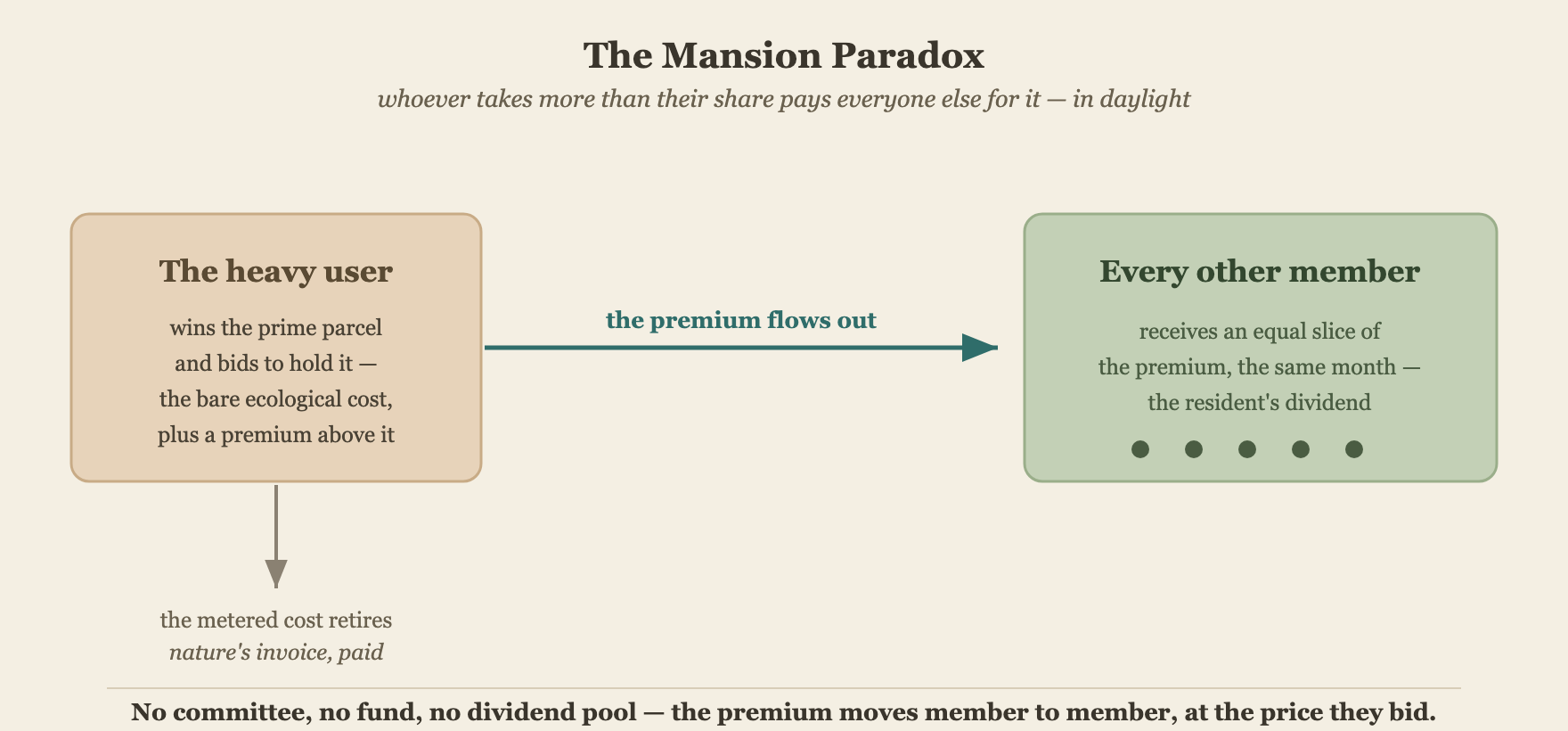
- The Mansion Paradox walks through a worked example of land use, ecological finance, and what happens when every citizen holds a tradeable share of the Earth’s surface as a birthright. The billionaire who wants the five-acre estate writes his check to the teacher in the city apartment, not the IRS. It extends Henry George’s argument from land rent to ecological cost.
- The Rare Earth Tailing Pond Dilemma is the stress test: how FME brings the dirtiest industry home to democracies without coercion, and how the markup turns being clean into the most profitable position in the market.
- Network State Identity shows how to implement FME today in voluntary communities using blockchain.
- Supply Chain Resource Tracking demonstrates a superior alternative to tariffs for managing strategic resource dependencies on foreign adversaries.
Critique
- Economic Calculation in the CBDC/Digital ID/Net Zero Commonwealth revisits Mises and Hayek’s critique of socialism in the context of modern digital surveillance and programmable money, and shows how FME achieves net-zero goals through incentive rather than mandate.
The Foundational Essay
How to run a real market economy inside a hard physical limit, and why almost every conventional instinct about how it must work is wrong.
There is one Earth, and we are not getting another. Whatever we do here we have to be able to keep doing for hundreds of thousands of years, because the alternative to a civilization that can last is a civilization that ends. The same problem shows up in miniature wherever humans live sealed inside a fixed envelope of resources: a nuclear submarine, the International Space Station, a future colony on Mars, a generation ship in deep space. In all of those places running out of air or water or fuel is not a market correction, it is a funeral, and so all of them are run as centrally planned economies in which an administrator decides in advance who consumes what. Earth has simply been large enough, for long enough, that we could pretend it was a different kind of place.
It is not a different kind of place, only a slower one. So the question I have spent years on is the one those sealed environments force but never answer: can you have a real market economy, with entrepreneurs and prices and competition and people getting rich, inside a hard physical limit you are forbidden to exceed? The two familiar answers both fail. Unconstrained capitalism is brilliant at producing cheap fish and perfectly content to produce the last fish, because its prices carry no information about the ocean having a bottom. Central planning respects the limit but cannot process the information of a real economy, and worse, once human welfare stops being the planner’s measure of success, a planner can hit its targets by destroying people as readily as by feeding them.
Free Market Ecology is my answer, and it is the most misunderstood thing I write about. Every reader arrives carrying a set of reflexes: a tax, a permit, a ration, a subsidy, a cap-and-trade scheme, a world government, a degrowth austerity program. At each step the framework gets quietly swapped for the nearest familiar item on that list, every one of which is wrong. The drift is so reliable that the cleanest way to explain the system is to build it one piece at a time and, at each piece, name the conventional reflex and say why it breaks. What follows is the framework from first principles, error by error.
The limit is physical, and it is the one thing the market does not get to vote on
Start with the only number that comes from outside the market. For every resource that can be drawn down faster than it returns, whether that is crude oil, aquifer water, fertile soil, fish stocks, the atmosphere’s capacity to absorb carbon, or ecologically load-bearing land, there is a maximum rate of use that can continue indefinitely without degrading the system that supplies it. That rate is a question for sustainability science, not for politics or willingness to pay, and it sets a hard ceiling on the physical quantity available in each period.
The reflex here is to picture a committee haggling that number up and down according to how badly everyone wants to consume. That is exactly what must not happen, because the entire point is to sever the quantity from demand. The cap is set conservatively and then tuned, and in practice the tuning runs only one way: revising a cap upward when the science turns out to have been too cautious breaks no one’s plans, while revising it downward breaks contracts, so you set it tight and treat the slack as the margin you loosen later. Inexhaustible inputs, such as sunlight and anything recycled out of the old economy, sit outside the cap entirely, which is the system quietly paying you to reuse what already exists.
This is the one genuinely planned element, and it is worth being honest that it is planned. But notice how little it decides. It fixes how much of each thing may be used. It says nothing about who uses it, or for what, or at what price, and everything interesting in an economy lives in those questions, which the cap deliberately leaves alone.
The state sets the limit, but it does not hand out the rights
Here is the first place the framework gets betrayed, including, years ago, by me. The obvious next move, once a central authority has fixed the ceiling, is to let that same authority parcel the quantity out: give each producer an annual allocation, issue each citizen a daily ration, run the whole thing off a central balance sheet. An earlier sketch of this system did exactly that, and it was the conventional reflex wearing the costume of a new idea. A government that allocates the rights is just central planning that has agreed to stop at the quantity. It still decides who gets oil, and it fails for the same informational reasons every command economy fails.
So the rights are not allocated. They are borrowed. A producer who wants to use a slice of the capped resource acquires the right to it on credit, from competing lenders I call Ecological Private Finance, and that right then clears on an open market. The central bank, which is really a federation of them, as later sections will show, mints no favors and picks no winners; it governs only the total, the way a monetary central bank governs a money supply without choosing who receives the loans. Who ends up holding the right to the last marginal barrel is settled by price and credit and the ordinary scramble of a market, not by an office.
If you find yourself describing a bureau that issues permits or rations consumption, you have left the framework and rejoined the planners. The cap is the only thing decided centrally. Allocation is always a market.
The unit is a physical right, not a price, and there is a different one for every kind of harm
This is the principle everything else hangs on, and the one the conventional mind dissolves fastest. The instinct is to hear all of this and conclude that it reduces to a price: put a number on environmental damage, charge it, and let the market sort out the rest. That is a carbon tax, and it is not what this is.
The accounting unit is not money. It is a physical Resource Usage Right, and there is a separate, non-fungible kind for each dimension of ecological cost: one for carbon, another for fresh water, another for a given class of land, another for a fishery. They are non-fungible in three directions at once, and each direction matters. They do not substitute: you cannot buy down the water cost of a product with cheap labor, or a subsidy, or a clever financial structure, because the right is denominated in water and only water settles it. They do not offset across dimensions: a water right cannot pay a carbon debt, because draining an aquifer and warming the air are not two sizes of the same thing, and any single number that lets one cancel the other is asserting a falsehood about the physical world. And they do not discount across time: a dead acre is dead whatever the interest rate, so the liability for long-horizon damage is carried at its full physical weight rather than shrunk to a present value the way money shrinks everything distant to almost nothing.
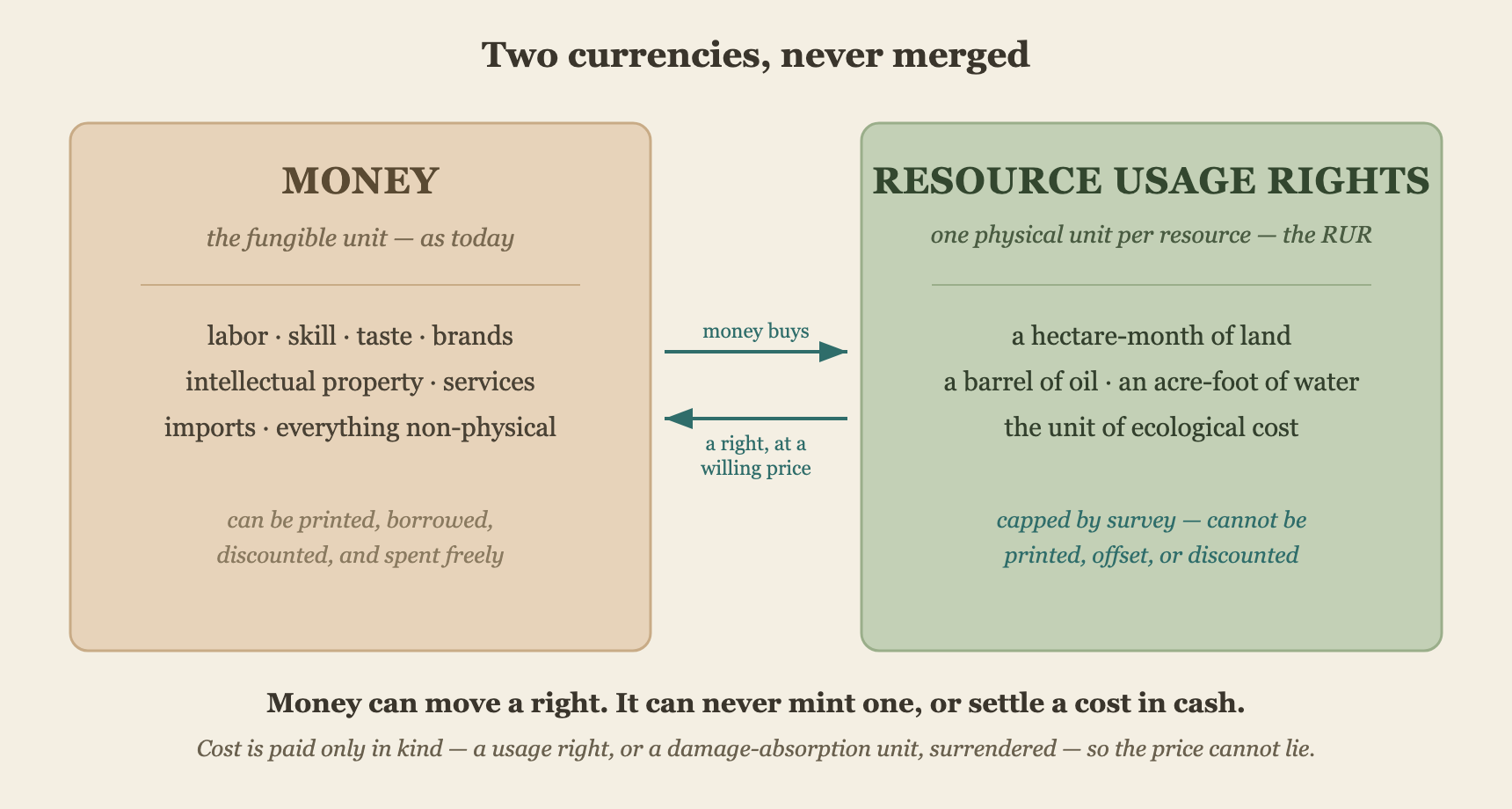
Money still exists, and it does most of what it does today: it prices labor, skill, ideas, intellectual property, reputation, everything humans value and trade that is not a draw on a capped physical resource. Money can even buy and sell the rights themselves. What it cannot do is the one thing that matters: settle an ecological debt. The obligation to cover the physical resource you actually used is discharged only by surrendering the matching physical right, never by paying cash in its place, because the moment a dollar could pay down a water debt, money would be buying down a resource cost and the substitution would be back. So money may buy you a water right, but only because some holder relinquished it for the money, and the cap fixes how many rights exist at all. The rights enter circulation through two channels, the universal income every citizen draws as a co-owner of the commons and what the government spends, and recirculate as the resource profit a producer earns. From there dollars only move them around; they never manufacture a right, shrink the rights embedded in a product, or stand in for surrendering a real one. So when someone says “a rising oil price pushes everyone toward solar,” they mean something exact: the price of the non-fungible oil right is climbing relative to the separate, non-fungible rights the solar pathway draws on, and producers are swapping one physical right for another. There is no master money price of “the environment.” There is a plural ledger of physically distinct scarcities, each debt settled in its own physical unit, and keeping them distinct is the whole achievement.
Damage is a liability you can only pay off in repair
What about the damage that does get done, the poisoned ground, the tailing pond, the stretch of seabed scraped bare? The familiar answer is the polluter-pays principle: charge the responsible party a fee, ideally a recurring one, and call the books balanced. But a fee paid in money for damage left standing in the world is the single-price error again, dressed up as justice; it lets cash stand in for a repair that never happens.
A liability in this framework exists only where physical damage exists, so where there is no damage there is no liability and nothing owed, and it is discharged only by physically undoing the damage, restoring the degraded land or letting the depleted system recover. You cannot settle it with a check, because the check un-poisons nothing. Nor does the liability sit forever on the producer who caused it as a perpetual fine; it is deposited downstream onto the account of the end beneficiary, the consumer who actually wanted the thing the damage produced, and in practice onto that consumer’s jurisdiction, which is what turns trade policy into the lever that manages it. One instinct from the first version of this idea was right about a single thing: if you take possession of something and throw it away unrecovered, the resource stays on your books. Generalize that and you have the principle: destruction is an outstanding debt against the physical world, payable in one currency only, which is restoration.
The framework is a machine, not a manifesto
It is tempting, and I have done this too, to load the system with values: to declare that nature comes first, that virgin land is sacred, that all human ends are subservient to the planet. That is a moral stance, and people are free to hold it, but it is not part of the machinery, and welding it on as though it were is a category error.
Free Market Ecology is a mechanism: it sorts ecological costs into non-fungible physical units, caps each at a sustainable quantity, and lets credit and markets allocate the rest. It does not dictate which buckets exist, where their boundaries fall, or which of them a society chooses to guard most jealously. Whether a particular forest is treated as untouchable or as ordinary working land is a political and jurisdictional decision made on top of the machine, not a law of the machine. This matters because a mechanism can be adopted by people who disagree profoundly about ends. A deep ecologist and a frontier industrialist can run the very same system and fight their fight inside it, through where each sets caps and draws classes, instead of having to first win a war over first principles. Keep the machine and the morality apart. The machine is the part that is new; the morality is the ordinary business of politics, and the framework is deliberately silent on it.
It runs on greed, and conservation is the profitable move
The deepest misreading is that all of this must hurt, that a system organized around physical limits has to be a program of austerity and sacrifice and being scolded into using less. It is the opposite, and that reversal is the core of the whole design.
Because the quantity is fixed, the only way to produce more value is to produce more value per unit of resource, and the producer who manages that pockets the spread between the near-zero physical damage of an efficient process and the market price of the right. That spread is a genuine profit, the reward for wringing more out of less of the Earth. The resource owner, holding a right to something that cannot be manufactured more of, gets rich by conserving it and selling its use dear rather than by dumping it cheap. Efficiency becomes the most profitable position in the market, which means the ordinary engines of capitalism, its competition and ambition and even its greed, are aimed straight at the environmental problem instead of against it.
This is also what kills the Jevons Paradox, the nineteenth-century observation that making a resource more efficient to use tends to make people use more of it, not less. That rebound runs on the quantity being free to expand. Here it cannot expand; the cap holds. So efficiency does not summon extra consumption; it frees the saved resource to satisfy some other want while the total draw on the Earth stays inside the line. Marx asked the right question, who captures the surplus a society produces, and answered it catastrophically. This is a different answer: the surplus goes to whoever creates the most value from the least nature, and that is a contest worth winning.
The citizens own the commons, and that is ownership, not redistribution
There is one more reflex to clear, the one that hears all this and calls it a scheme to take from the rich and hand to the masses. It is nothing of the kind, because there is no one to expropriate. The commons, meaning the atmosphere, the aquifers, the fisheries, and the capped resources every producer must draw on, belongs to the citizens to begin with; it is not seized and redistributed after the fact. Producers still develop it, mark it up, and grow wealthy. What changes is only that the resource they draw on has owners, and those owners are everyone.
This becomes the decisive question as automation advances. For two centuries ordinary people have held a claim on the economy through their labor: they had something to sell. When machines can do the work for less than it costs to keep a human worker fed, that claim evaporates, and a population with nothing to sell is a population with no stake in the economy that has replaced it. That is the precondition for every ugly future, from mass dispossession to the factions warring over who controls the robots. Free Market Ecology hands that population a different and durable claim: ownership of the physical commons that all production, automated or not, must still buy its way into. A machine-run process owes no wages, so its goods are nearly free in money terms, but it still has to acquire the non-fungible rights to the resources it consumes, and those rights are owned by the citizens. The income every citizen draws is paid in exactly those rights and in nothing else. It is a flow of RURs, not money: the commons paying out each owner’s share of the physical resources the economy has to use. There is no free money in it. Anything that still takes human labor must still be bought with money, and money is still earned by working, so if others have to work, you have to work too. The one way to avoid working is to want almost nothing: a citizen who lives on a very tight resource budget leaves part of his allocation unspent, and those unused rights can be sold for money to people who want to consume more, so the very frugal can live on the proceeds of the share they decline to use. Even then the money is not free, because it is paid for by giving up the physical consumption the rights represent. What this universal resource income removes is not the need to work but the threat of being cut off from a share of the Earth itself, and that share is grounded not in charity or redistribution but in property, the one kind of standing a robot cannot underbid.
No one is in charge
The last reflex is to assume that running all of this demands a single authority, a global environmental government empowered to set the world’s caps and police them. That would be both impossible and dangerous: impossible because no such authority could ever be agreed to, dangerous because a single point of control over every physical resource on Earth would be an irresistible target for capture.
So there is no global government, and its absence is a feature. The system is a nested federation of jurisdictions, each setting and bearing the consequences of its own caps, the way many central banks coordinate without a world central bank above them. Discipline between jurisdictions that do not trust each other comes not from treaties but from self-interest and from a ledger. Every rule is enforced by the party whose own interest it serves: a jurisdiction that issues rights carelessly is left holding the unsettled liabilities, so it issues carefully; a country sitting on a depleting resource guards its cap the way a cartel guards supply, because the scarcity is its wealth; every citizen is a part-owner of the commons, so untracked extraction is theft from each of them. The provenance of every resource is tracked on a shared blockchain, not because the technology is fashionable but because two rivals who each suspect the other of cheating, over how much oil was really burned or whether it was made with hidden subsidies and coerced labor, can both rely on a ledger that has to close. The chain forces the books to balance between adversaries who agree on nothing else.
What the machine adds up to
Step back and the whole thing is a single device. Physics fixes how much of the Earth may be used. Markets and credit, not officials, decide who uses it and for what. The accounting is kept in plural physical rights that cannot be substituted, offset, or discounted away, so no clever price can launder a real harm. Damage is a debt against the world, payable only in repair and charged to whoever benefited. Conservation is the most profitable move on the board, so greed pushes toward sustainability instead of away from it. The citizens own the commons, which gives them a claim that outlives the usefulness of their labor. And no one is in charge, because the discipline lives in the incentives and the ledger rather than in a ruler.
That device maps, in the trivial case, onto exactly the careful allocation a submarine or a space station already performs by hand. But unlike the submarine it scales, because it does the allocating through markets instead of through an administrator who must somehow know everything. It is the economy you could run on Mars, on a ship in deep space, and on a near-future Earth that has finally noticed it is one of those sealed environments too, only larger and slower.
I called the first version of this an outline, and it leaned on the state to do the work because that was the reflex I had not yet shaken off. The framework’s actual content is everything that reflex gets wrong. Hold onto the corrections above and you have it; reach for the conventional neighbor at any step, whether the tax, the permit, the ration, the world government, or the program of sacrifice, and you have lost it. The detailed mechanics of each piece are what the companion essays are for.