A five-minute orientation to Free Market Ecology, and four doors into it.
The one sentence
Free Market Ecology gives ecological cost its own physical currency — one that cannot be printed, offset, or discounted — so that ordinary markets, not central planners, do the conserving.
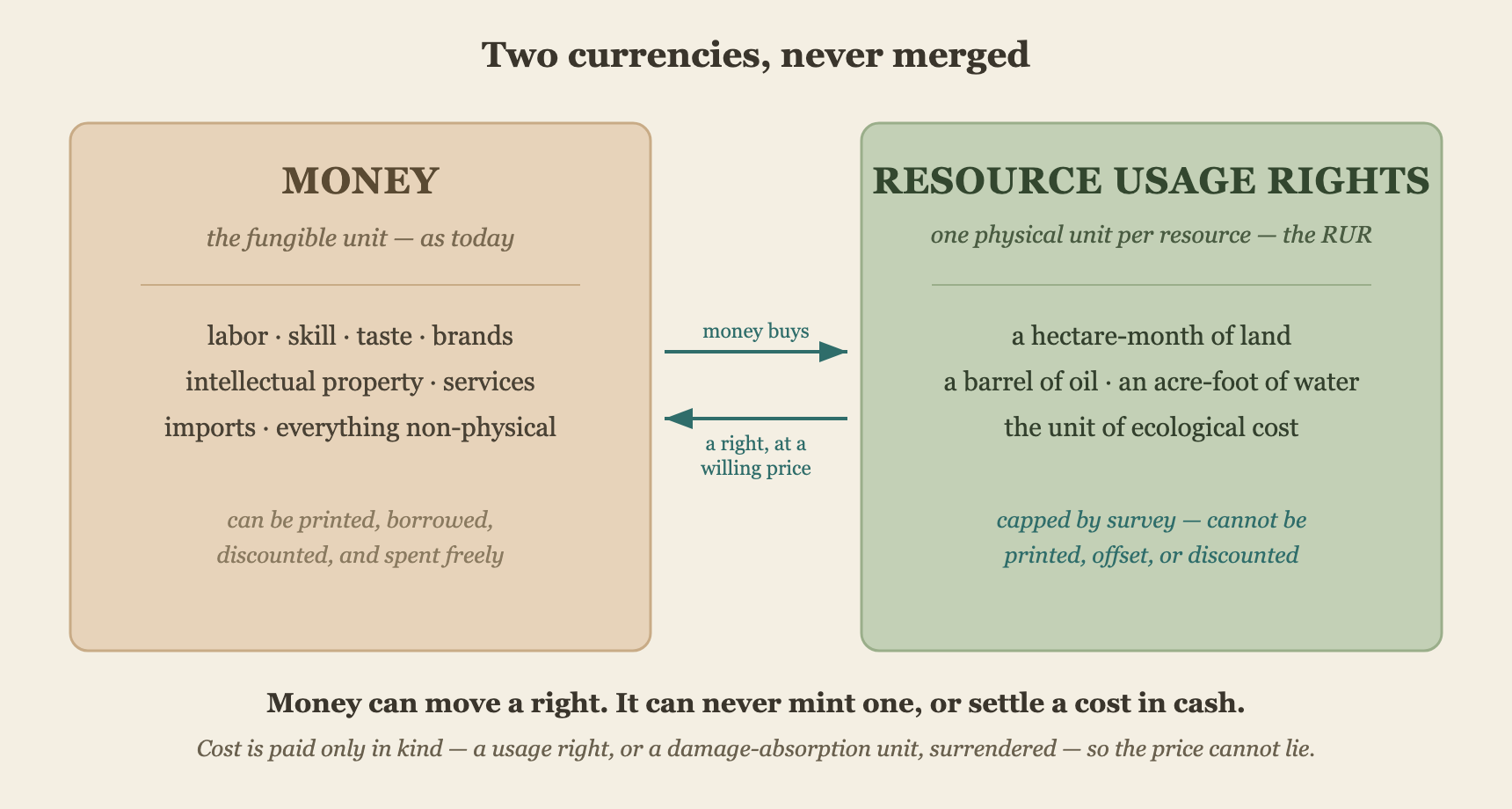
The thirty seconds
Capitalism processes information about labor and capital better than any planner, and almost nothing about the environment — because ecological cost carries no price the system can’t game. Money buys it down, a discount rate shrinks it, an offset launders it, a permit financializes it. So the price of the Earth always ends up lying.
Free Market Ecology denominates that cost in a resource usage right — a physical, non-fungible unit, one per resource, capped by survey, that money can move but never mint. A producer borrows it as a debt, embeds it in what they make, and the debt is settled only when a consumer surrenders a real right of their own. Give the price a unit that can’t lie, and the market conserves on its own — no bans, no central planner, no ration book.
What it does not do is decide any political question. How much to cap, who gets what, who may immigrate, whether to rescue a failing bank — all of that is still politics. The books just stop lying about what was decided.
Pick a door
You do not have to read it in order. Start with whatever you came for.
- If you’re a skeptical environmental or resource economist → Free Market Ecology for Skeptical Environmental Economists. A direct comparison with the toolkit you already know — Pigouvian taxes, cap-and-trade, catch shares, water rights and the rest — stating what FME changes in each and what it does not claim.
- If you’re worried about AI and jobs → The Number Nobody Chooses. What the end of wage labor does to who the economy keeps on its books — and why a property claim beats a stipend when the robots arrive.
- If you think markets already beat scarcity → The Last Whale. Julian Simon was right that markets substitute around shortage — and why the robot era is exactly when that stops being true. The Austrian case, in Hayek’s own terms.
- If you’d rather see it run than read about it → West Mazupo, a playable village where the whole system operates — the currency, the credit, the market-clearing, the drought, the robots — tick by tick.
- If you want the whole machine, built error by error → First Principles. The complete system assembled one piece at a time, naming the conventional reflex it rejects at each step, and ending with the open problems it does not claim to solve.
- If you’d rather attack it than read it → The Corner-Case Challenge. The hundred and one ways I tried to break the framework, opened to everyone — find the one it can’t handle, and it goes in the ledger under your name.
The map
The rest of the site goes deeper along four lines:
- The story — The Abdication runs the whole framework through a century on one island: how the owner grew richer by giving it up.
- The theory — The Mansion Paradox (density without bans), The Last Barrels (peak oil), and Extending Capitalism’s Logic.
- The financial system — how ecological central banking and private finance actually work: the overview, then The Unusual Afterlife of a Failed Loan (credit that only settles at the consumer) and What Free Market Ecology Doesn’t Handle (the line between the books and the ballot).
- The applications — AI safety, national security, and the rare-earth tailings problem, among others.
A note on method: this framework was hardened with an adversarial process — every mechanism attacked in fresh context before it shipped, and the recurring ways the argument drifted documented as they were caught. It is meant to be broken. If you find a case it can’t handle, that is exactly the contribution the project is looking for.